
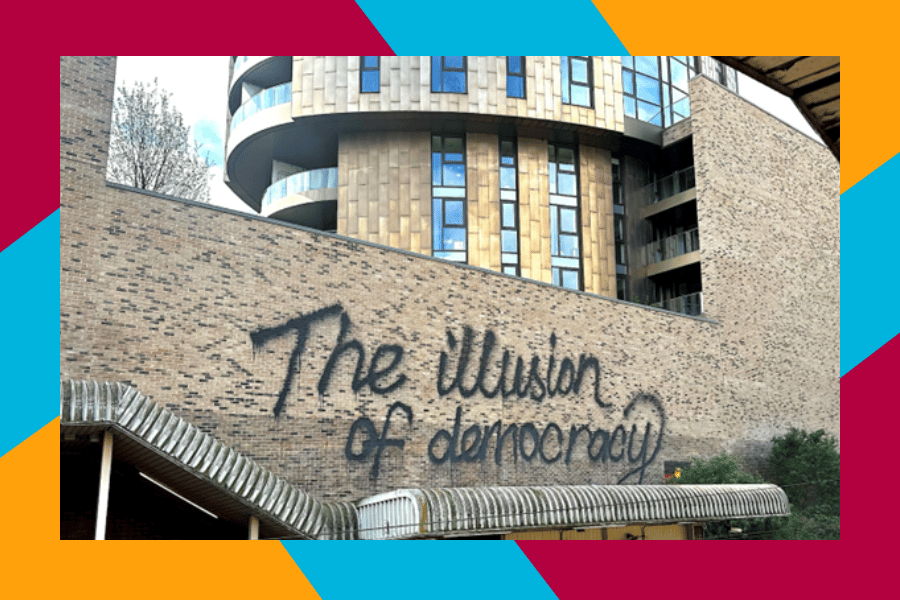
Dr Amy Burnett (LPIP Place Fellow), Dr Jason Leman (Citizen Network) and Dr Daniel Ozarow (Middlesex University) examine how town and parish councils could play a central role in making devolution work for communities. This discussion paper was developed following the National Association of Local Councils’ Power Shift Conference and responds to the English Devolution and Community Empowerment Bill. In particular, they reflect on the implications of a neighbourhood governance pathway on the configuration of democracy under the emerging devolution landscape on town and parish councils.
“Town and parish councils are essential place-based, locally-driven institutions that can reflect and voice diverse community cultures that are crucial for supporting local action.”
Dr Amy Burnett, Dr Jason Leman and Dr Daniel Ozarow
Town and parish councils must be recognised, resourced, and integrated as the essential democratic bridge between communities and larger governance structures in the devolution landscape – not supplemented or replaced by new arrangements that ignore centuries of local democratic practice.
Meet the Authors
Dr Amy Burnett
Amy is an LPIP Place Fellow and a Research Fellow in Inclusive and Sustainable Enterprise at the Centre for Enterprise, Environment and Development Research (CEEDR) at Middlesex University’s (MDX) Business School. Her research and practitioner work focuses on civil society groups and government to promote and incentivise innovative and sustainable development in the context of sustainable finance, planning, policy, placemaking, place-based identities and digital transitions. She is an active member of the GreenFin MDX research cluster. Amy is also a Research Fellow at the Centre for the Understanding of Sustainable Prosperity (CUSP) and a former British Academy Policy Innovation Fellow at the Department for Culture, Media and Sport (DCMS), where she focused on policy innovation on valuing the Voluntary, Community and Social Enterprise (VCSE) sector.
Dr Jason Leman
Jason is a researcher in democracy and politics and has two decades of experience in research and activism, having co-founded several campaign groups and working within and around political parties. His academic study focuses on independent local political parties, town and parish councils, and the (actual and ideal) character of democracy at a local level. Jason is also Neighbourhood Democracy Lead at Citizen Network, an organisation which works to connect and support global efforts to build communities that welcome, support and activate full and meaningful citizenship for everyone.
Dr Daniel Ozarow
Dan is a Senior Lecturer at Middlesex University Business School and a researcher of autonomous political, social and economic movements. He has published articles on workers’ self-management, how protest movements develop electoral and non-electoral mechanisms and how class alliances emerge and can be sustained through economic mobilising vehicles and citizen neighbourhood assemblies. He has sat on an advisory body to the Local Government Association and is currently researching local authorities and modern slavery. He is also a community activist, a recently elected Mayor and a town councillor in Elstree and Borehamwood.