
This report, by Alice Pugh, City-REDI, University of Birmingham, examines the capacity and capability of officers working in strategic authorities to develop, commission, scrutinise and use business cases and economic appraisals, while also considering the implications of devolution for place-based investment and assurance.
The report draws on a mixed-methods survey of 88 officers from 57 UK strategic authorities. Combining descriptive analysis of closed survey responses with thematic analysis of qualitative comments, it provides a detailed picture of how appraisal is undertaken across different places and organisations.
The findings reveal a clear mismatch between appraisal responsibilities and the resources available to support them. While respondents generally report confidence in contributing to business cases, this confidence is strongest in strategic and management cases. Confidence is lower in the more technical economic, financial and commercial cases, where specialist expertise is often required.
Significant capability gaps also emerge. More than three-quarters of respondents have never held a Better Business Cases Green Book appraisal qualification, while 62% report having little or no dedicated appraisal expertise within their organisation. Limited staff capacity, fragmented governance arrangements, restricted access to evidence and specialist skills, and reliance on consultants were all identified as barriers to effective appraisal practice.
Although consultants provide valuable expertise, respondents highlighted concerns that over-reliance on external support can limit institutional learning and weaken authorities’ ability to commission, challenge and assure externally produced work. Many also questioned whether current appraisal requirements are proportionate to the scale and risk of projects, and to the capacity of the organisations responsible for delivering them.
The report concludes that improving appraisal practice requires a systemic approach that goes beyond formal training alone. It recommends targeted capacity building, shared specialist resources, clearer guidance on proportionality, practical case studies, improved access to evaluation evidence, stronger feedback mechanisms, and better alignment between external funding timetables and local governance processes. Together, these measures could help strategic authorities strengthen their appraisal capability and support more effective place-based investment and decision-making.
“Strategic authorities are operating within a demanding appraisal environment in which expectations are rising faster than capacity and capability are being developed.”
Alice Pugh, City- REDI, University of Birmingham
Central government, strategic authorities, universities and professional bodies must collaborate to strengthen place-based appraisal. Coordinated investment in accessible training, pooled expertise, practical evidence, proportionate requirements and constructive feedback is essential. Building this institutional capability will ensure devolved responsibilities support robust decisions, stronger accountability, public value and place-sensitive outcomes.
Key findings
Uneven expertise
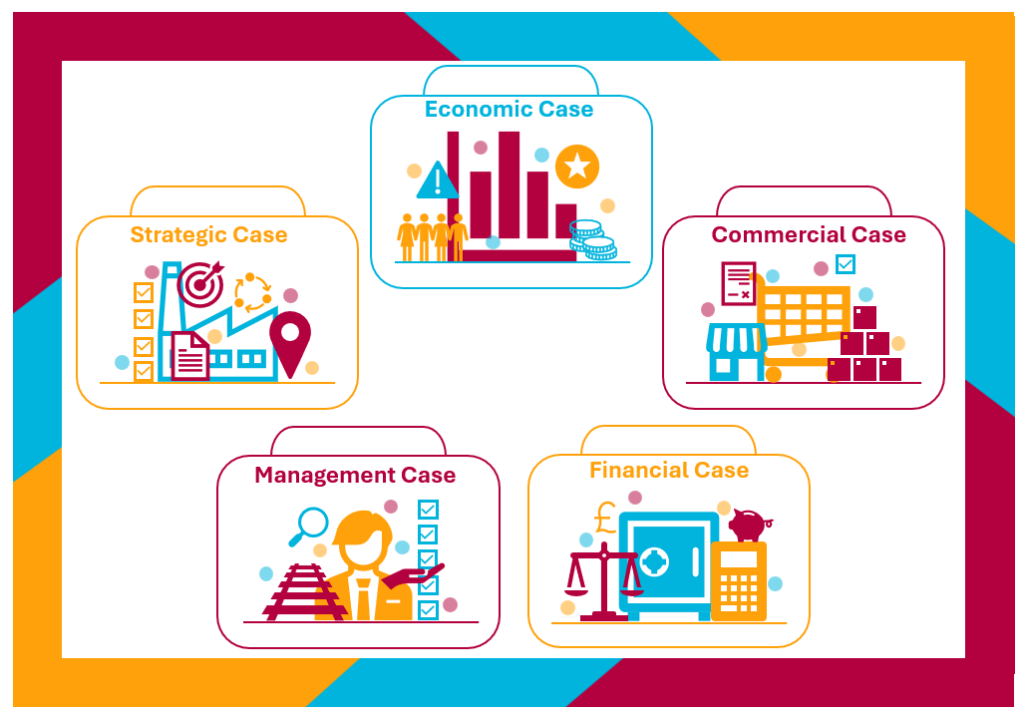
Officer confidence is uneven across the business case five-case model. Respondents were more confident in their ability to contribute towards the strategic and management case, but less confident in their ability to contribute to the economic, financial and commercial cases. Therefore, officers were less confident where greater technical expertise was required; the economic case was highlighted as presenting the greatest technical challenge.
Further to this, appraisal expertise is limited or unevenly distributed. The majority of respondents reported that their organisation had little or no dedicated business case or economic appraisal expertise, or that expertise was concentrated in particular teams and spread thinly across the wider organisation.
Limited training
Formal training in business case and Green Book appraisal is limited. More than three quarters of respondents had never held a Better Business Case Green Book appraisal qualification, suggesting that many officers engage with complex appraisal processes without systematic professional development in the relevant methodology.
Outsourcing to Consultants
Consultants are widely used to fill capacity and expertise gaps. External consultants are commonly used for specialist expertise, economic cases, value for money assessments, technical analysis and assurance. While this support is often necessary, over-reliance may weaken internal capability if authorities lack the expertise to commission, scrutinise and challenge consultant work effectively.
Concerns around proportionality
Officers did not reject the need for rigorous business cases and economic appraisal but questioned whether requirements are always proportionate to project scale, risk, funding value, delivery timescale and organisational capacity. This concern was reflected for both external funding opportunities and external funding opportunities.
Governance bottlenecks
Governance processes can create bottlenecks. Respondents described business case approval processes as often involving multiple levels of sign-off, including directors, finance teams, boards, committees and political decision-makers. Governance challenges can also be compounded by weak assurance expertise. These processes can be lengthy and difficult to align with external funding deadlines.
Demand for practical support
Amongst practitioners there is strong demand for practical support. Respondents identified evaluation evidence, good practice case studies, workshops and guidance on the use of business cases and economic appraisals internally by strategic authorities, amongst other practical tools, as useful mechanisms for improving capacity and capability.
Recommendations
1 – Develop a targeted capacity-building programme for strategic authorities
Central government, working with strategic authorities and relevant professional bodies, should develop a targeted programme to strengthen business case and economic appraisal capacity across local and regional government. This should include formal training, applied workshops and practical support focused on the areas officers find most challenging. This programme should not be limited to officers in analytical roles. Business case development is a cross-disciplinary process; training and support should therefore be designed for different levels of technical need.
2 – Improved access to Better Business Case and Green Book training
Central government should review the accessibility, cost and suitability of existing training routes for local and regional government. Greater access to training would help improve technical confidence, but it would also support a shared language and common understanding of appraisal expectations across government departments, combined authorities, local authorities and delivery partners.
3 – Establish a national or cross-regional knowledge-sharing network
A national or cross-regional appraisal knowledge-sharing network should be established to support officers involved in business case development, economic appraisal and assurance. To be effective, the network should be practical, problem-focused and sustained over time, rather than a one-off engagement exercise.
4 – Create a repository of good practice business cases, templates and case studies
Central government should develop a curated repository of business case materials that demonstrate robust, proportionate and place-sensitive appraisal in practice. This should include examples from different policy areas, authority types, project scales and stages of the business case process.
5 – Provide clearer guidance on proportionality for local and regional appraisal
Central government should provide clearer guidance on how appraisal requirements should be scaled according to project value, risk, complexity, delivery timescale, intervention type and availability of evidence. This guidance should be developed with strategic authorities to ensure it reflects the realities of place-based delivery. This would help strategic authorities maintain rigour while avoiding unnecessary process burdens.
6 – Strengthen internal assurance and intelligent client capability
Given the high level of consultant use, strategic authorities need sufficient internal expertise to commission, manage, challenge and assure external work. Capacity-building should therefore focus not only on producing business cases, but also on becoming more effective intelligent clients. This should include guidance and training in the assurance of business cases and economic appraisals.
7 – Explore pooled or shared appraisal resource models
The report identifies strong support for pooled specialist capacity. Strategic authorities, universities, anchor institutions and other place-based partners should explore shared appraisal resource models that allow expertise to be distributed more effectively across places. Pooled models could provide smaller authorities with access to economic appraisal, financial modelling, evaluation, data and assurance expertise that they could not sustain individually. They could also reduce duplication, improve consistency and reduce over-reliance on external consultants. This may be particularly important in a devolved governance context where more investment decisions will be made locally and regionally.
8 – Improve access to evaluation evidence
Respondents identified access to evaluation evidence as the most useful form of support. Central government should improve access to evaluation evidence from previous programmes and interventions. This would help authorities develop stronger evidence bases, improve assumptions, assess likely impacts and avoid repeatedly commissioning similar evidence from scratch.
9 – Introduce more systematic feedback on funding bids
Strategic authorities would benefit from more constructive feedback on both successful and unsuccessful business cases submitted for external funding. The survey found strong support for feedback as a mechanism for improving future capability. This would support organisational learning and help authorities improve the quality of future submissions.
10 – Align external funding timetables with local governance requirements
Central government departments should consider how external funding deadlines interact with local governance and assurance processes. Short bidding windows and tight turnaround requirements can undermine the quality of appraisal, particularly where authorities must navigate multiple internal approval stages. Where possible, funding processes should allow sufficient time for evidence development, options appraisal, internal scrutiny and political decision-making. This would improve the quality of submissions and reduce the incentive to retrofit pre-selected projects into business case templates.
11 – Further research in the future
The most insightful elements of this survey have been the text-based responses, in which strategic officers were given space to provide in-depth answers. Further research should be developed with strategic authorities, offering officers the opportunity to provide more in-depth, robust responses, investigate the capacity and capability challenges that strategic officers face, and propose potential solutions.